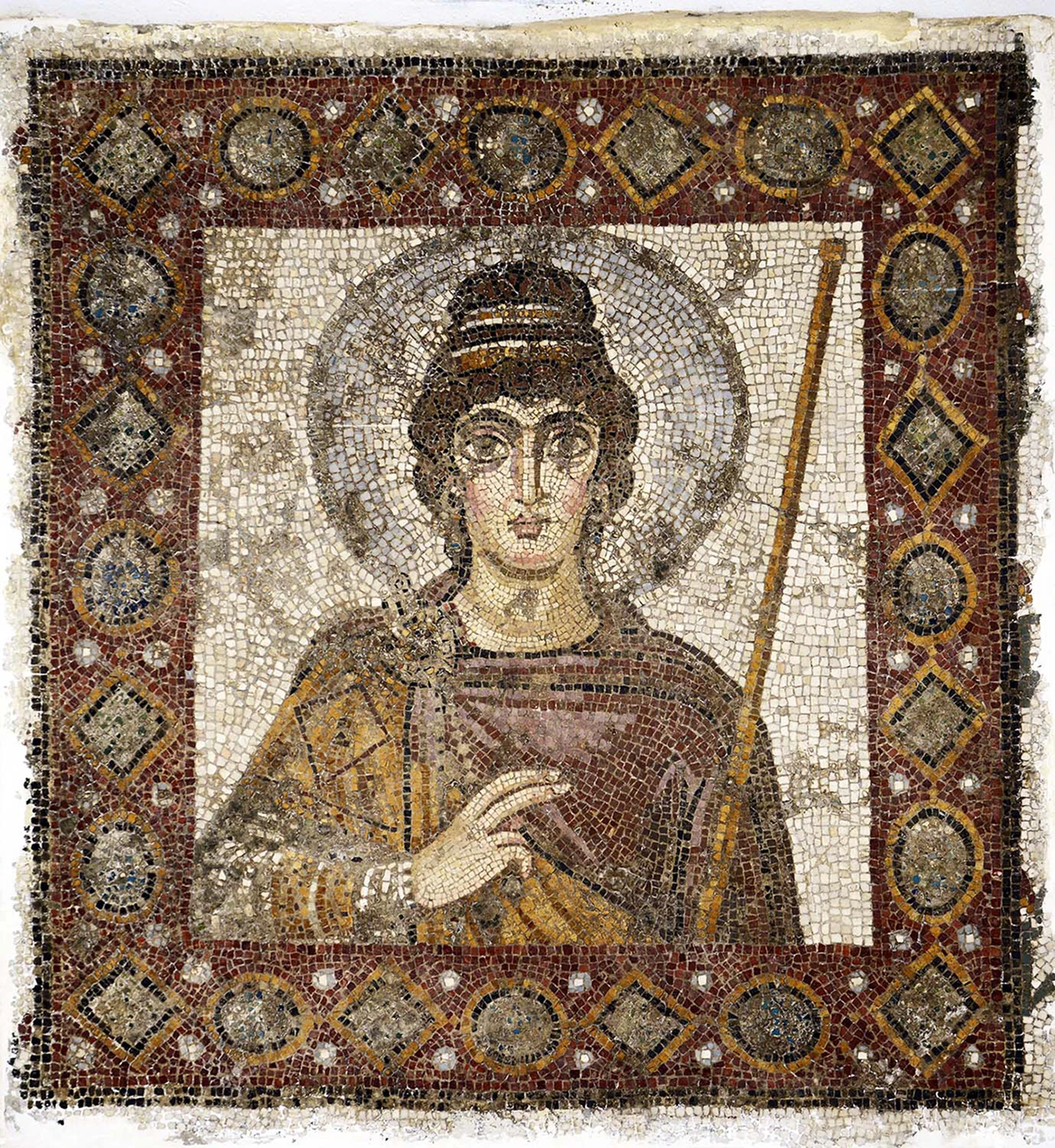
« La dame de Carthage »
Ve-VIe siècle (108 x 102cm)

Découverte en 1953 dans une villa tardive sur la colline de Sayda, A Carthage.Musée de Carthage.

« The Lady of Carthage »
Vth-VIth century (108 x 102 cm)

Discovered in 1953 in a late villa on Sayda Hill, Carthage. Carthage Museum.

Elle est habillée avec une sous-tunique, une tunique et un manteau (“paludamentum”), porte un long sceptre doré surmonté d’un globe et une auréole brille derrière sa tête.
Le personnage, qui possède deux merveilleux yeux en amande, un nez oblong et un menton arrondi, semble donner la bénédiction avec la main droite.

Sa simplicité aristocratique, avec sa coiffure sobre en turban noué par un simple ruban rouge, la touche d’élégance représentée par les quelques bijoux (deux boucles d’oreilles en or) et son apparence austère révèlent une attitude conservatrice orientée vers les normes comportementales traditionnelles.
Le visage, plein d’expressionnisme, est énigmatique.

She is dressed in an under-tunic, a tunic, and a cloak (“paludamentum”), carries a long golden scepter surmounted by a globe, and a halo shines behind her head. The figure, with its two marvelous almond-shaped eyes, oblong nose, and rounded chin, appears to be giving a blessing with its right hand.

Its aristocratic simplicity, with its understated turban tied with a simple red ribbon, the touch of elegance represented by the few pieces of jewelry (two gold earrings), and its austere appearance, reveals a conservative attitude oriented towards traditional behavioral norms.
The face, full of expression, is enigmatic.